
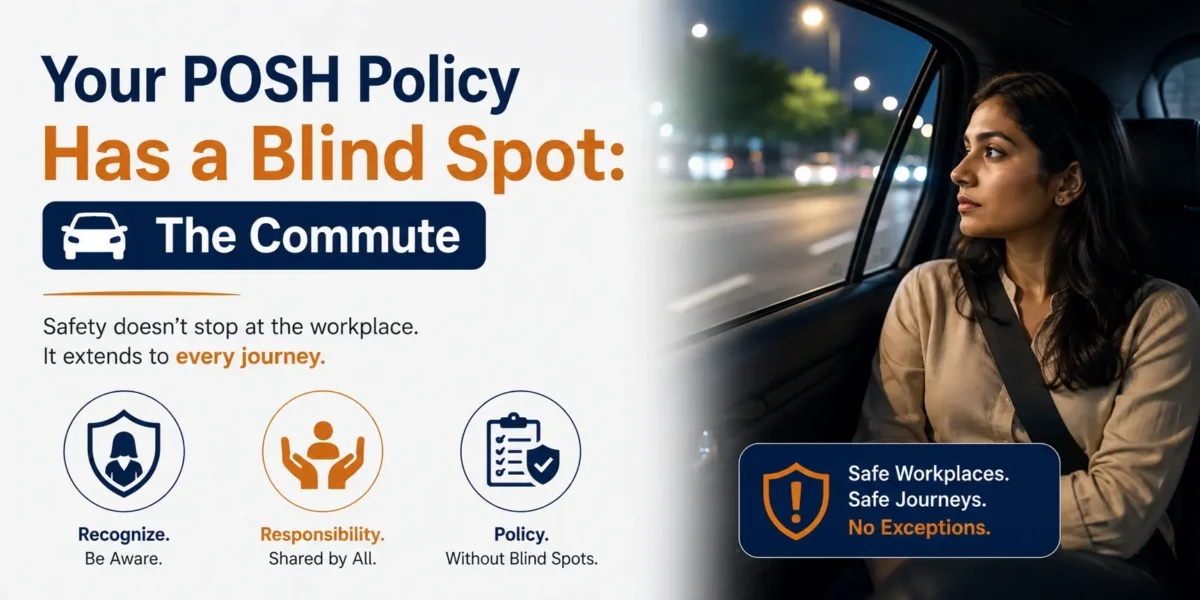
The Shared Auto Loophole Nobody’s Policy Covers
A woman employee says she was sexually harassed by a male colleague. Not in the office. Not in a cab the company booked. In a shared autorickshaw both of them happened to take on the way to work.
Her company’s Internal Committee (IC) looked into it and found the man guilty.
He went to the Bombay High Court. His argument: the IC had no business deciding this case at all, because the incident didn’t happen at a “workplace.”
The High Court agreed with him.
Here’s the part that matters: the Court did not say the harassment didn’t happen. It said the IC was never the right authority to decide it, because under the POSH Act, transport is only counted as “workplace” if the employer arranges it. A shared auto two colleagues happen to take together does not meet that test.
So the finding got quashed — not cleared, quashed. The question of what actually happened in that auto is now sitting in limbo, with no forum clearly empowered to answer it.
Why This Should Worry Every HR Head and IC Member, Not Just Lawyers
- Most POSH policies say “workplace and during commute” without checking whether the commute is actually employer-arranged. If it isn’t, your IC may have zero jurisdiction — and any finding it gives can be challenged and thrown out, years later, regardless of merit.
- Employees increasingly carpool, share cabs, or travel together informally. None of that is covered unless your company specifically arranges it.
- A wronged employee can end up with nowhere to go — the IC can’t touch it, and there’s no automatic alternative remedy unless the company has built one (service rules, code of conduct, disciplinary policy that’s broader than POSH).
What We’d Tell Our Clients to Fix This Week
- Define “workplace” in your POSH policy with the actual statutory test — employer-arranged transport, not “commute” as a vague catch-all.
- Build a parallel disciplinary mechanism (under service rules / code of conduct) for misconduct that falls outside POSH’s definition, so nobody falls through the gap.
- Train your IC to check jurisdiction first, before going into merits. Skipping this is exactly what got the finding overturned.
A policy that doesn’t draw this line clearly isn’t protecting anyone — it’s creating false confidence.