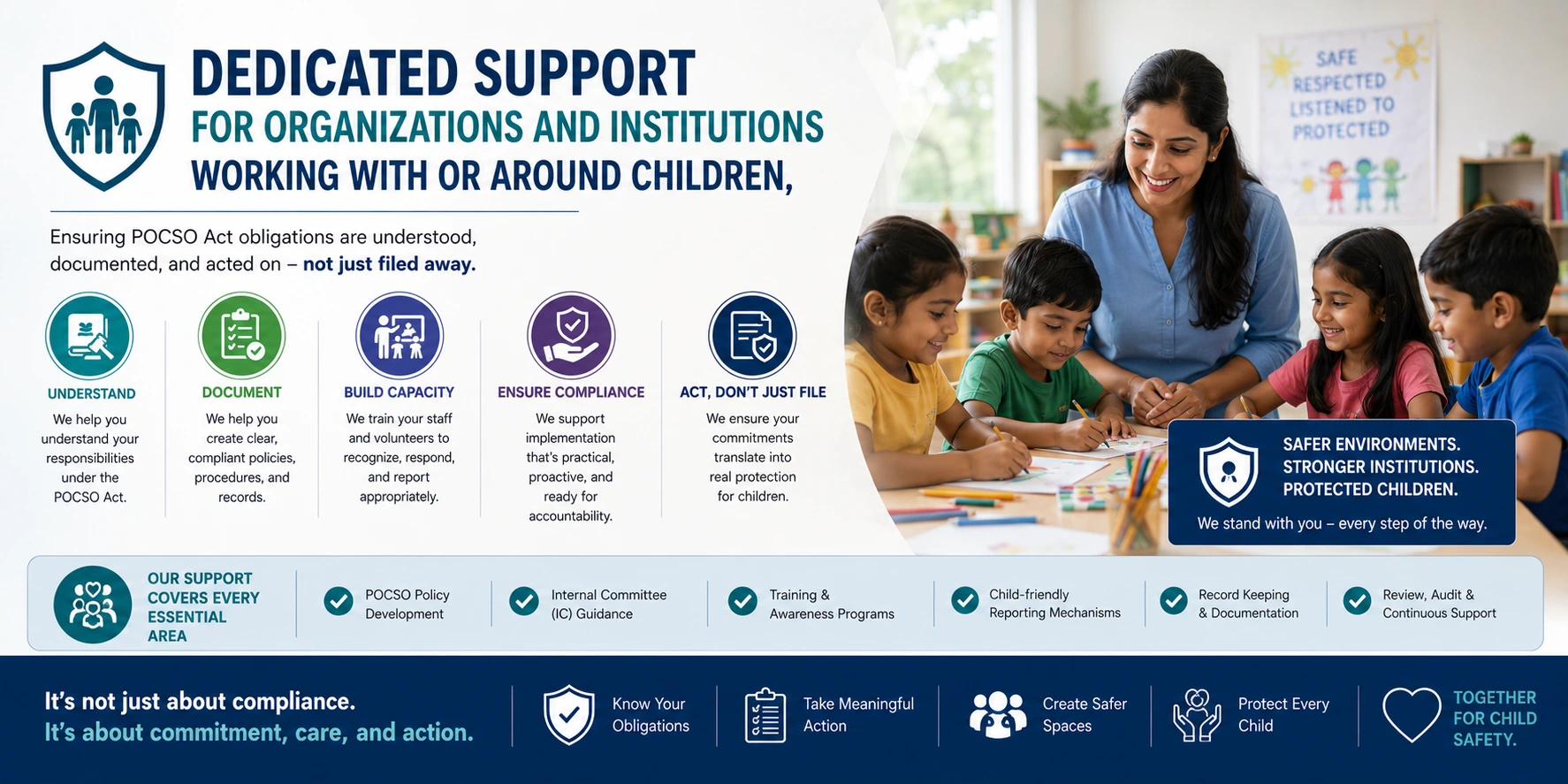
Dedicated support for organizations and institutions working with or around children, ensuring POCSO Act obligations are understood, documented, and acted on - not just filed away.
Child protection compliance gets treated as an afterthought more often than any other part of this page, usually because the organisations that need it – schools, coaching centres, hospitals, sports academies, NGOs working with minors – assume general POSH coverage is close enough. It isn’t. The POCSO Act creates its own distinct obligations, and institutions working with or around children carry legal responsibility that a standard workplace harassment policy doesn’t touch.Our approach starts with training built for the actual audience: age-appropriate awareness sessions for students, separate sessions for staff and educators on recognition and mandatory reporting duties, and briefings for parents where the institution wants that layer covered too. Every session is designed by trainers with genuine grounding in child development and safeguarding practice, not a POSH deck lightly re-labelled for a younger audience – that distinction matters more here than almost anywhere else on this page.
What’s included:
- POCSO awareness training and workshop sessions, tailored by age group and role
- POCSO policy formation and implementation support
On the policy side, we help institutions draft and implement child protection policies that meet POCSO Act requirements: mandatory reporting procedures, safe reporting channels for children themselves, staff conduct guidelines, and the documentation trail that shows the policy is active and not just adopted. We work directly with school administrators and institutional leadership so implementation doesn’t stall after the policy is signed off – a gap we see often, where a strong document exists and nobody has actually operationalised it.
Recognition training for staff gets particular attention in our sessions, because POCSO places a direct legal reporting obligation on adults who become aware of abuse, and hesitation or uncertainty at that moment carries consequences for the child and for the institution. We work through what mandatory reporting actually requires in practice, how to handle a disclosure from a child without unintentionally causing further harm during the conversation, and how the institution’s internal process should connect to external reporting channels once a concern is raised. This is deliberately not treated as a legal formality delivered in the abstract – staff leave the session knowing what to do in the specific moment it’s needed, not just what the law says in general.
Student-facing sessions are built with equal care on the developmental side. Age-appropriate does real work in that phrase: a session for primary-age children looks nothing like one for adolescents, in language, format, and the concepts introduced, and getting that calibration wrong can do more harm than running no session at all. Our trainers are chosen specifically for grounding in child development alongside POCSO knowledge, and sessions are built to help children understand their own right to safety and how to speak up, without frightening content or material that oversteps what’s appropriate for the age group in the room.
Because every institution’s structure, age range, and risk profile is different, pricing and scope for this service are worked out directly with you rather than fixed to a standard package. What stays constant is the standard we hold it to: documented, acted-on compliance, not a policy filed away and forgotten until something goes wrong.