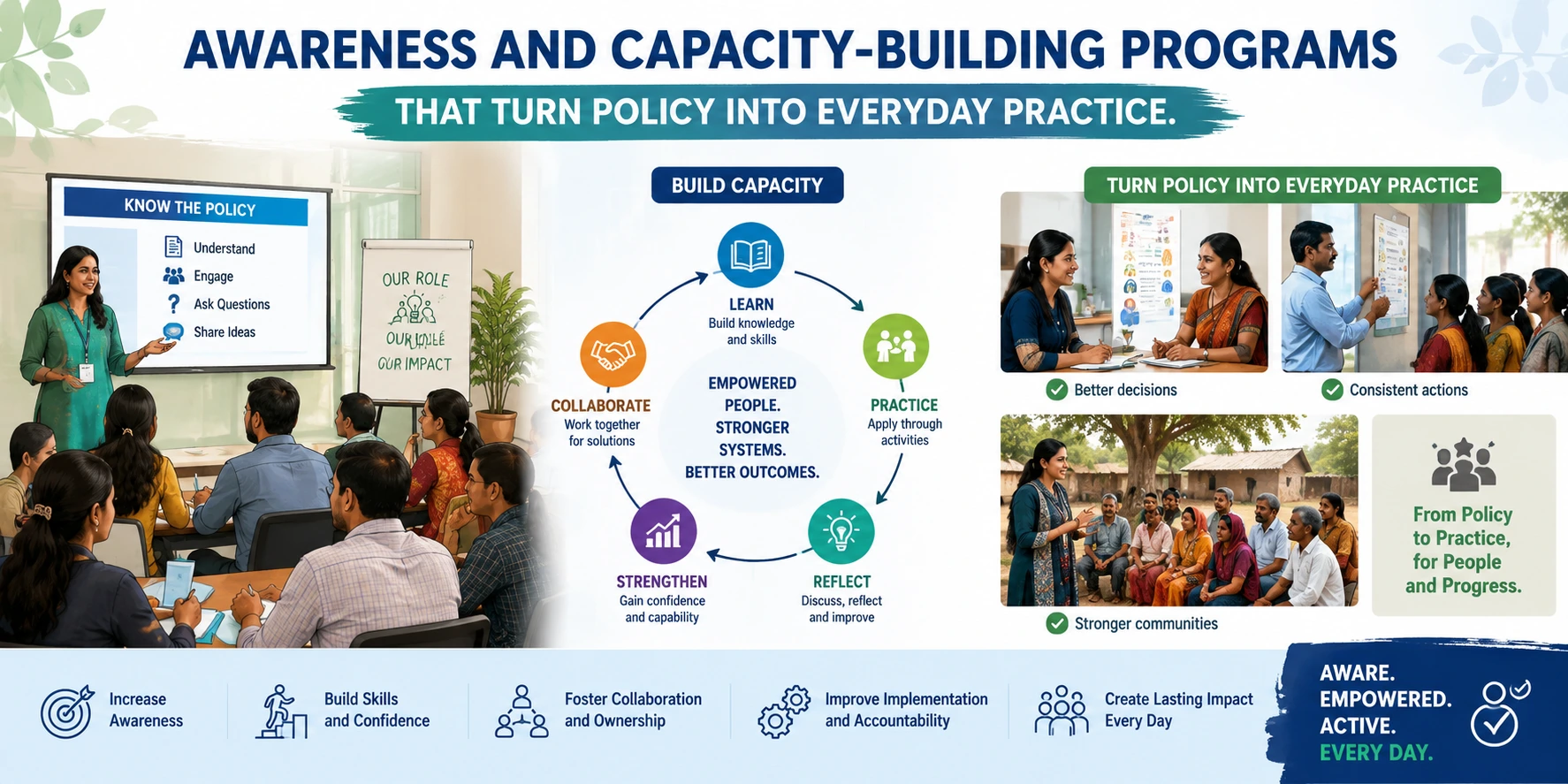
Awareness and capacity-building programs that turn policy into everyday practice.
A policy tells people what the rules are. Training is what makes people actually believe the rules apply to them. The gap between the two is where most workplace harassment cases actually originate – not from a missing document, but from a culture where nobody was ever walked through what harassment looks like in practice, what the reporting process actually involves, or why the committee exists in the first place. This service closes that gap directly.Our core offering is the Employee Awareness and Sensitization Workshop – a session built for the general workforce, covering what constitutes harassment under the POSH Act, what protections and obligations exist for everyone involved, and how the complaint and inquiry process actually works from the first report to resolution. We keep this gender-neutral by design: safety at work is not a women’s issue framed for a mixed audience, it’s a shared standard everyone is expected to meet and everyone is protected by.
Internal Committee members get a separate track. IC Capacity Building is built specifically for the people who will conduct inquiries, weigh evidence, and write findings – a very different skill set from general awareness, and one that determines whether your IC’s decisions hold up if challenged. We cover natural justice principles, confidentiality obligations, inquiry procedure, and the practical judgment calls that training manuals tend to skip.
What’s included:
- Employee Awareness/ Sensitization Workshop
- IC Capacity Building
- Culture-Building Initiatives
- Safe workplace and campus culture programs
- Minutes of Meeting and full session records included
Beyond the mandated sessions, we run Culture-Building Initiatives and broader safe workplace or campus culture programs for organisations that want to go past the compliance minimum – leadership sessions, bystander intervention training, sector-specific modules for schools, hospitals, or manufacturing floors where the risk context is different from a corporate office. A leadership team that has never sat through the same training it mandates for junior staff sends its own message, whether intended or not, and we design senior-track sessions specifically to close that gap rather than exempt leadership from it.
Format matters as much as content. We run sessions in person where the setting benefits from it – factory floors, school campuses, hospital departments – and online where distributed teams make travel impractical, without diluting the interaction into a one-way lecture either way. Sessions are kept conversational and scenario-based rather than slide-heavy, because harassment training that people sit through passively tends to be forgotten by the time it’s actually needed. We also calibrate language and examples to the audience – a session for a manufacturing floor looks different from one for a corporate sales team, and a session for school staff looks different again from one built for hospital shift workers.
Every session, regardless of format, closes with Minutes of Meeting and full documentation, so the training isn’t just delivered, it’s provable. That documentation matters twice over: once for your compliance file, when Section 19’s awareness obligations are checked, and once for the cultural signal it sends internally – that this organisation takes the topic seriously enough to keep a record, not just run a session and move on. For organisations building a training calendar rather than a single session, we also help structure a recurring cadence – annual refreshers, onboarding sessions for new hires, and periodic IC-specific updates – so awareness doesn’t quietly expire the way a one-time workshop tends to.