
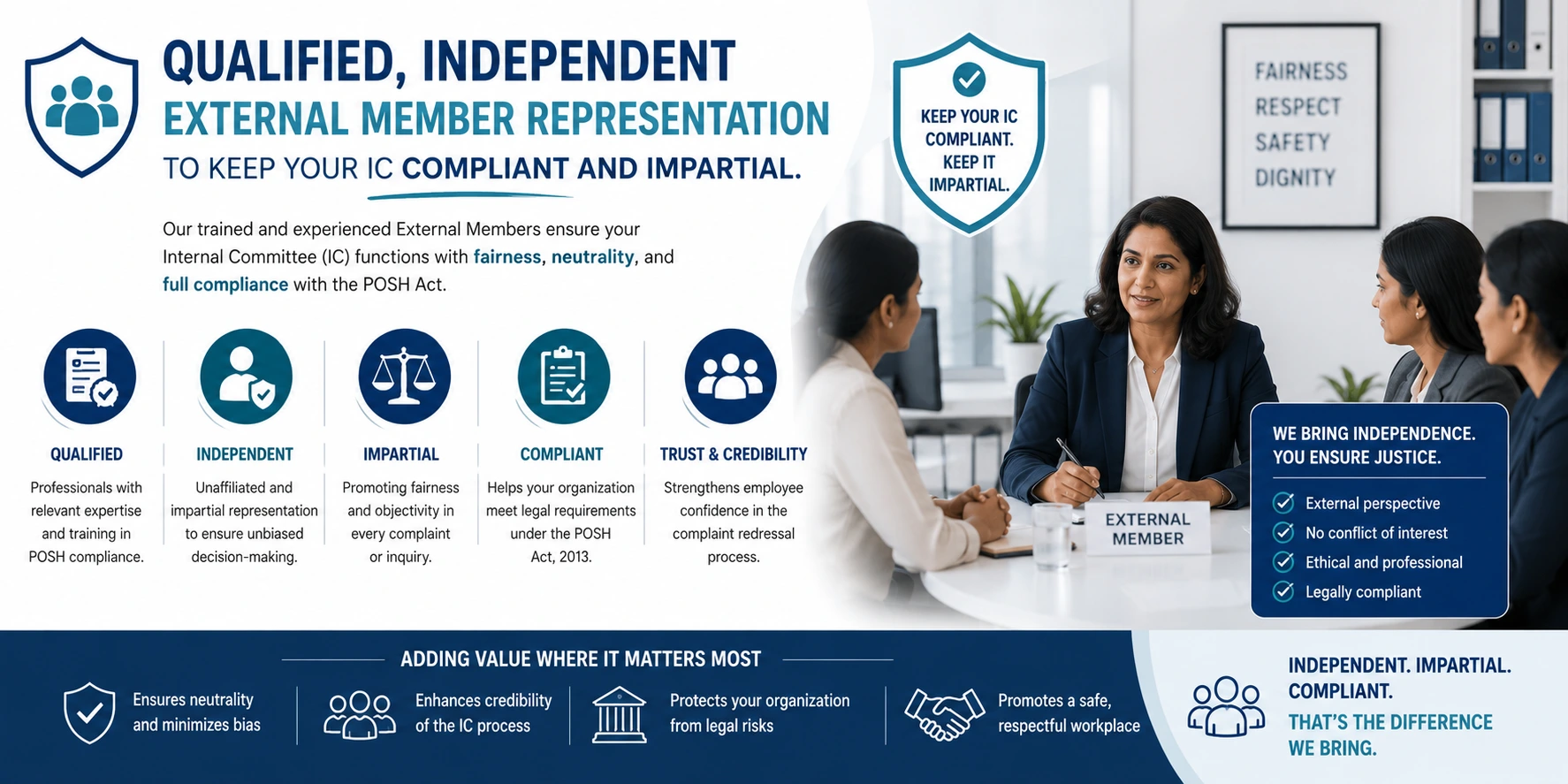
Qualified, independent External Member representation to keep your IC compliant and impartial.
An Internal Committee without a valid External Member is not legally compliant, full stop – and it’s one of the most commonly missed requirements we encounter, often in organisations that assume they’re covered because every other box is checked. The POSH Act requires this role specifically because internal committees, made up of colleagues and managers, carry an inherent risk of bias or pressure that an outside member is meant to counterbalance.We provide qualified, independent professionals to serve in this role – individuals trained specifically as POSH External Members, not general consultants filling a seat. Their presence ensures your IC meets the Act’s composition requirements and gives your process a genuinely independent voice during inquiries, someone with no reporting line, no internal politics, and no stake in the outcome beyond a fair one.
What’s included:
- Serving as qualified External Member on the Internal Committee
- Ensures POSH Act-compliant IC composition
- Independent oversight during proceedings
- Advisory support to the committee
- One-year renewal terms, with three-year IC tenure options available
It’s worth being direct about scope here: this is an advisory and oversight role on the committee, not an operational management function for your broader compliance program – that sits under our Compliance Services. What it does give you is a defensible IC structure and a member who brings inquiry experience your internal panel may not have, without the cost or complexity of hiring a full-time compliance hire.
The value of this role tends to show up most clearly during an actual inquiry rather than in the day-to-day. Internal committee members, however well-intentioned, sit inside the same reporting structure as the parties involved – they may know the complainant, report to the respondent, or feel pressure, spoken or not, from leadership about how a case should conclude. A qualified External Member changes that dynamic simply by being outside it, with the trained ability to flag procedural issues, question assumptions the internal panel might not think to question, and put weight behind a finding purely on its merits. Several organisations bring us in only after a first inquiry ran into trouble – a challenged finding, a procedural gap raised in appeal, a committee that froze under an unfamiliar case – and this is the role we most often see filling that specific gap going forward.
Terms run for one year with renewal, and organisations that want longer continuity can arrange a three-year IC tenure, matching the natural cycle of committee reconstitution under the Act. We also provide advisory support to the committee between active cases – answering composition questions, reviewing whether a new inquiry needs escalation, and helping the IC stay current as the law or your workforce changes – so the role isn’t dormant until a complaint arrives. For most organisations, this is the fastest, lowest-friction way to fix an IC composition gap that could otherwise invalidate an inquiry outcome entirely, and it’s frequently the first thing we recommend fixing when a compliance review turns up a gap in committee structure.