Child Protection Begins Long Before a Crime Occurs
The recent sexual assault and murder of a minor in Nasrapur, Maharashtra, has shaken the conscience of the nation. While the legal process will determine accountability and justice, the incident has once again highlighted a painful reality — our children continue to remain vulnerable despite the existence of stringent laws.
Every such tragedy leaves behind grieving families, traumatised communities, and difficult questions for society. Could this have been prevented? Were there missed warning signs? Are our institutions truly prepared to safeguard children?
For organisations, schools, childcare institutions, healthcare facilities, NGOs, sports academies, residential communities, and every adult entrusted with a child’s safety, this is more than a news story. It is a reminder that safeguarding children requires continuous vigilance, awareness, and accountability.
The POCSO Act: More Than a Legal Framework
The Protection of Children from Sexual Offences (POCSO) Act, 2012 was enacted to protect children from sexual offences while ensuring child-friendly procedures for reporting, investigation, and trial. However, the true purpose of the legislation extends beyond prosecution. The Act seeks to create environments where:
- Children feel safe and protected.
- Adults understand their safeguarding responsibilities.
- Institutions establish preventive systems.
- Abuse is identified and reported at the earliest.
- Every complaint is handled with sensitivity, confidentiality, and urgency.
Compliance alone cannot protect children. Prevention must become part of organisational culture.
What the Nasrapur Case Teaches Us
1. Child Safety Cannot Be Reactive
Safeguarding should never begin after a child has been harmed. Every institution working with children should proactively establish:
- Child Protection Policies
- Safe reporting mechanisms
- Staff awareness programmes
- Behavioural guidelines
- Risk assessment processes
- Periodic safeguarding reviews
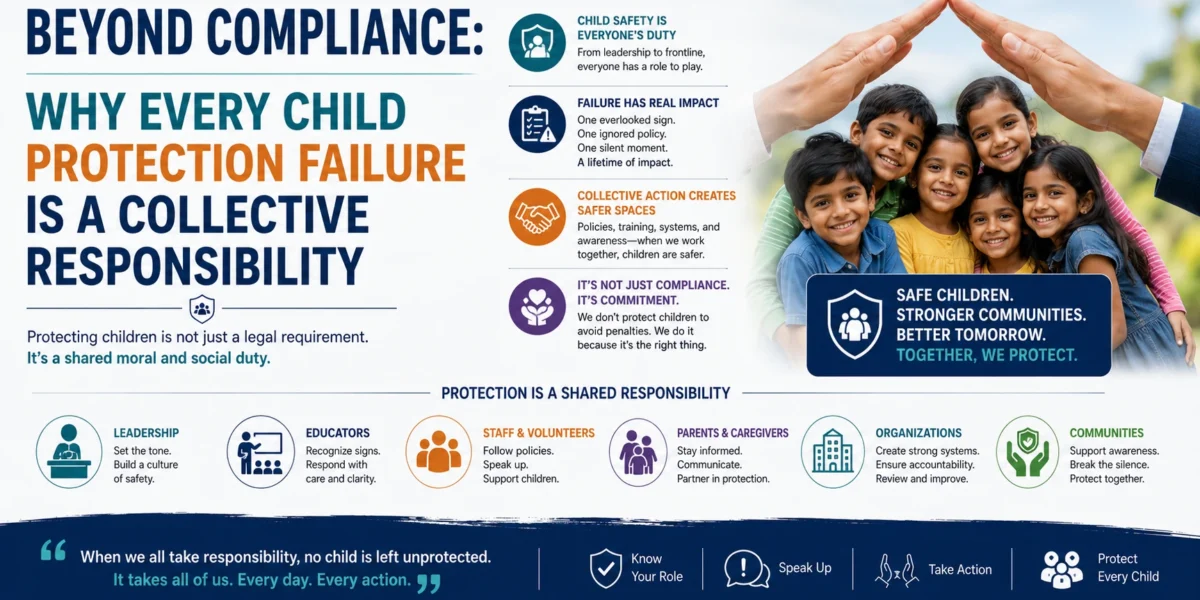
Child protection is most effective when it is embedded into everyday operations — not activated only after a crisis.
2. Every Adult Has a Safeguarding Responsibility
A common misconception is that protecting children is solely the responsibility of parents. In reality, every adult interacting with children shares that responsibility. This includes:
- School leadership
- Teachers and educators
- Healthcare professionals
- Transport providers
- Coaches and trainers
- Security personnel
- Housekeeping staff
- Volunteers
- Community members
Safeguarding is not defined by job titles. It is defined by responsibility.
3. Awareness is the First Line of Defence
Many instances of child sexual abuse occur because children do not recognise unsafe behaviour or are afraid to disclose it. Age-appropriate body safety education empowers children to understand personal boundaries, recognise inappropriate behaviour, differentiate between safe and unsafe touch, identify trusted adults, and speak up without fear.
Equally important is educating adults to respond appropriately when a child discloses abuse. Listening without judgement and acting without delay can make a life-changing difference.
4. Institutions Must Invest in Prevention
Preventing abuse requires more than awareness sessions. Organisations should implement comprehensive safeguarding measures, including:
- Background verification of personnel.
- Child Protection Policies aligned with legal requirements.
- Mandatory safeguarding training.
- Clear reporting and escalation procedures.
- Regular audits of child safety practices.
- Defined roles and responsibilities for safeguarding.
An effective safeguarding framework reduces risks while building trust among children, parents, employees, and the wider community.
5. Justice Must Be Swift and Child-Centred
The effectiveness of any child protection law depends not only on its provisions but also on timely implementation. Prompt reporting, efficient investigation, sensitive handling of child victims, and timely judicial processes reinforce confidence in the justice system while minimising further trauma.
Building a Culture Where Children Feel Safe to Speak
Research consistently indicates that many children delay or never disclose abuse because they fear disbelief, blame, or punishment. Creating safe environments means teaching children that their body belongs to them, they have the right to say “No,” no inappropriate touch should be kept secret, trusted adults are there to protect them, and asking for help is a sign of courage — not weakness.
At the same time, adults must create an environment where children know they will be heard, believed, and supported. Child protection begins with communication.
The SafeGen Advisories LLP Approach
At SafeGen Advisories LLP, we believe that every child deserves to grow, learn, and thrive in a safe environment. Our approach focuses on prevention through awareness, policy, and preparedness. We support organisations by providing:
- Child Protection Policy drafting and review
- POCSO awareness and sensitisation programmes
- Safeguarding training for educators, caregivers, healthcare professionals, and support staff
- Advisory on child protection compliance
- Risk assessments and safeguarding audits
- Guidance on reporting mechanisms and institutional preparedness
Conclusion
The recent incident in Nasrapur is a painful reminder that safeguarding children cannot be treated as an occasional initiative or a statutory obligation. It requires continuous commitment from institutions, professionals, families, and society alike.
Every child deserves a childhood free from fear. Protecting that childhood is not the responsibility of one law, one institution, or one parent. It is a shared responsibility — one that demands awareness, action, and unwavering commitment from us all.